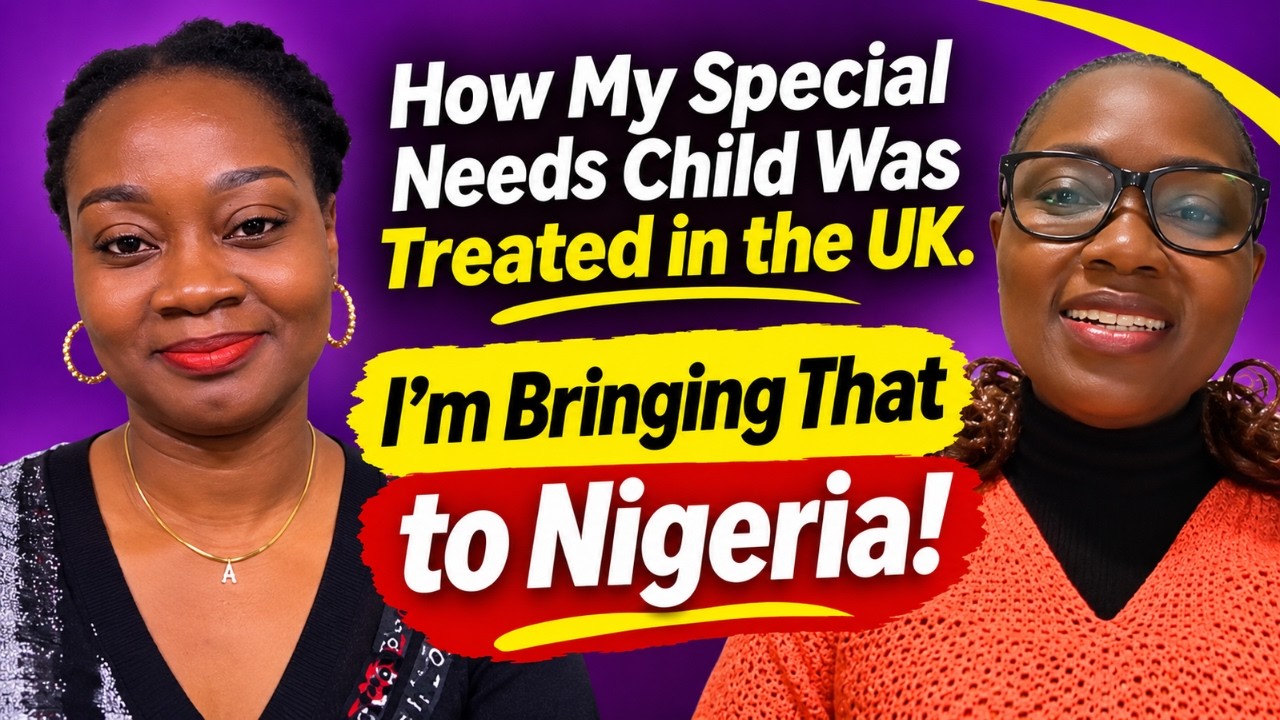
On 18 November 2026 the journalist Adeola Fayehun published a 41-minute interview with Olufunke Adeloye, our co-founder and Chief Executive. It is their second conversation. In the first, in February 2024, Olufunke told the story of her daughter Abigail.
Abigail died in October 2024, a week after her 16th birthday. In this interview Olufunke talks about that loss, about why she did not stop, and about what is now happening in Ogbomoso.

Interview, 41 min
How My Special Needs Child Was Treated in the UK. I’m Bringing That to Nigeria!
From Adeola Fayehun’s YouTube channel. It plays here in YouTube’s privacy-enhanced mode, and Google’s privacy terms apply once you press play.
Why she kept going
Olufunke does not pretend the last two years have been easy. Some days, she says, she does not want to get out of bed. She also says that when Abigail died she knew she had given everything she could, and that walking away from disability work would have been understandable: “If I’d wanted to drop it, it would have been okay.”
What kept her going was other families. Children and parents in Nigeria, she says, need to know that “there can be dignity in care”, and that every child, with or without a disability, is valuable and made in God’s image.
Why The Bridge opened before OAK Centre Prime
OAK Centre Prime is our long-term plan: a campus for children and young people with disabilities from birth to 25, with a day centre and places to live, built so that it can be copied elsewhere in Nigeria. Olufunke describes it as a five-year plan.
Our free medical outreach in April changed the timetable. More than 100 children and young people came, and Olufunke says about 32 of them were found that day to have cerebral palsy. Many were teenagers who had never had a diagnosis or any physiotherapy.
“A week of physio, what difference that can make,” she says. So rather than wait, we found a building in the centre of Ogbomoso, renovated it and opened it as a day centre. That is The Bridge.
It was commissioned on a Friday. “By Monday we had four families that came in.”
What The Bridge offers families
Olufunke describes two kinds of support.
The first is for children who depend fully on a parent for their care, as Abigail did. After an assessment, a family can come three days a week, four hours at a time, for 12 weeks. Trained staff look after the child downstairs. The parent goes upstairs to rest, and there is a bedroom if they want to sleep. Over three months that adds up to 144 hours of rest. “Some of them have never had that before.”
The second is for children who are already in school. They come once a week after school for play sessions that draw out whatever each child can do. The Bridge is not a school, and it does not replace one.
The Bridge does not provide medical treatment either. We are working with teaching hospitals in Ogbomoso so that families can be referred in both directions, and we point parents to the schools and services that already exist. There are also plans for vocational training, so that parents who have lost their income because of caring can earn again.
“That is what your son can do”
One story from the interview stays with you. A 14-year-old boy came to The Bridge with a relative who believed his disability was the result of a spiritual attack on the family. While the adults talked, Olufunke put him on a mat with a basket of coloured balls.
Before long he had sorted them by colour. “I said, that is what your son can do,” she recalls. For her the lesson is that “there’s nobody that doesn’t have any skill”. There is always something, and “we just need to find it”.
Her message to parents
Adeola Fayehun asked Olufunke to speak directly to parents who are tired, and to families who hide a child’s disability. Her answer began: “I want to give you a big hug to say I can see you. I see you.” And then: “You are not alone.”
She asks parents to see their child as made in the image of God, to keep looking for help, and to look after themselves too, even if it is five minutes alone in a day. To people of faith who are praying for healing, she says she believes in miracles, and that while we wait, “let’s show up for the children. Let’s care for them. Let’s love them.”
And more than once: “Please don’t give up.”
What would help
Asked what OAK needs, Olufunke lists specialist seating and equipment, and volunteers from the diaspora, especially therapists. “This cannot be done by just one person or one institution,” she says. If you would like to offer equipment or your time, please get in touch.
Watch, share and give
We are grateful to Adeola Fayehun for inviting Olufunke back, and for asking viewers to support this work.
The interview came out during our November appeal for our work in Nigeria, including The Bridge. Thank you to everyone who has already given. Eligible gifts through our New Africa Fund page this November can be matched 1:1 once US$500 is raised, up to US$5,000. You can give or follow the appeal here.